

Object-Oriented Programming (OOP) is a fundamental programming paradigm that helps in organizing and structuring code in a modular, reusable way. By the end of this guide, you’ll have a clearer understanding of OOP principles and how they work in Python. We’ll cover the following essential concepts:
- Classes and Objects
- Attributes and Methods
- Encapsulation
- Inheritance
- Polymorphism
1. Classes and Objects
What is a Class?
A class is like a blueprint for creating objects. Imagine you’re building a blueprint for a type of car. You would define properties (like color, make, model) and behaviors (like drive, stop). Each specific car is an object created from that blueprint.
In programming, a class defines the properties (called attributes) and behaviors (called methods) of an object.
What is an Object?
An object is an instance of a class. It’s like a specific car built from the car blueprint. Each car has its unique attributes and can perform actions, like driving or stopping.

Example Code for Classes and Objects
Here’s an example of a Car class in Python:
class Car:
    # Constructor to initialize attributes
    def __init__(self, make, model, color):
        self.make = make       # Attribute
        self.model = model     # Attribute
        self.color = color     # Attribute

    # Method to describe the car
    def describe(self):
        return f"This car is a {self.color} {self.make} {self.model}."

# Creating objects (instances) of the Car class
car1 = Car("Toyota", "Corolla", "blue")
car2 = Car("Ford", "Mustang", "red")

# Using the describe method
print(car1.describe())   # Output: This car is a blue Toyota Corolla.
print(car2.describe())   # Output: This car is a red Ford Mustang.
2. Attributes and Methods
- Attributes: These are the variables that belong to an object and define its characteristics. For example, make, model, and color in the Car class.
- Methods: These are functions within a class that define behaviors for the object. For example, describe() in the Car class.
Example of Attributes and Methods in Python
class Book:
    def __init__(self, title, author, pages):
        self.title = title         # Attribute
        self.author = author       # Attribute
        self.pages = pages         # Attribute

    def read(self):                # Method
        return f"You're reading '{self.title}' by {self.author}."

# Create a book object
book1 = Book("The Great Gatsby", "F. Scott Fitzgerald", 218)

# Accessing attributes and methods
print(book1.title)          # Output: The Great Gatsby
print(book1.read())         # Output: You're reading 'The Great Gatsby' by F. Scott Fitzgerald.
3. Encapsulation
Encapsulation is about keeping data safe from outside modification by making attributes private. You can control access to an attribute by using getter and setter methods.

Example Code for Encapsulation
class BankAccount:
    def __init__(self, owner, balance):
        self.owner = owner              # Public attribute
        self.__balance = balance        # Private attribute

    # Getter for balance
    def get_balance(self):
        return self.__balance

    # Setter for balance
    def set_balance(self, amount):
        if amount >= 0:
            self.__balance = amount
        else:
            print("Invalid balance amount!")

# Testing encapsulation
account = BankAccount("Alice", 1000)
print(account.get_balance())  # Accessing private attribute via getter method

account.set_balance(2000)     # Modifying private attribute via setter method
print(account.get_balance())  # Output: 2000
4. Inheritance
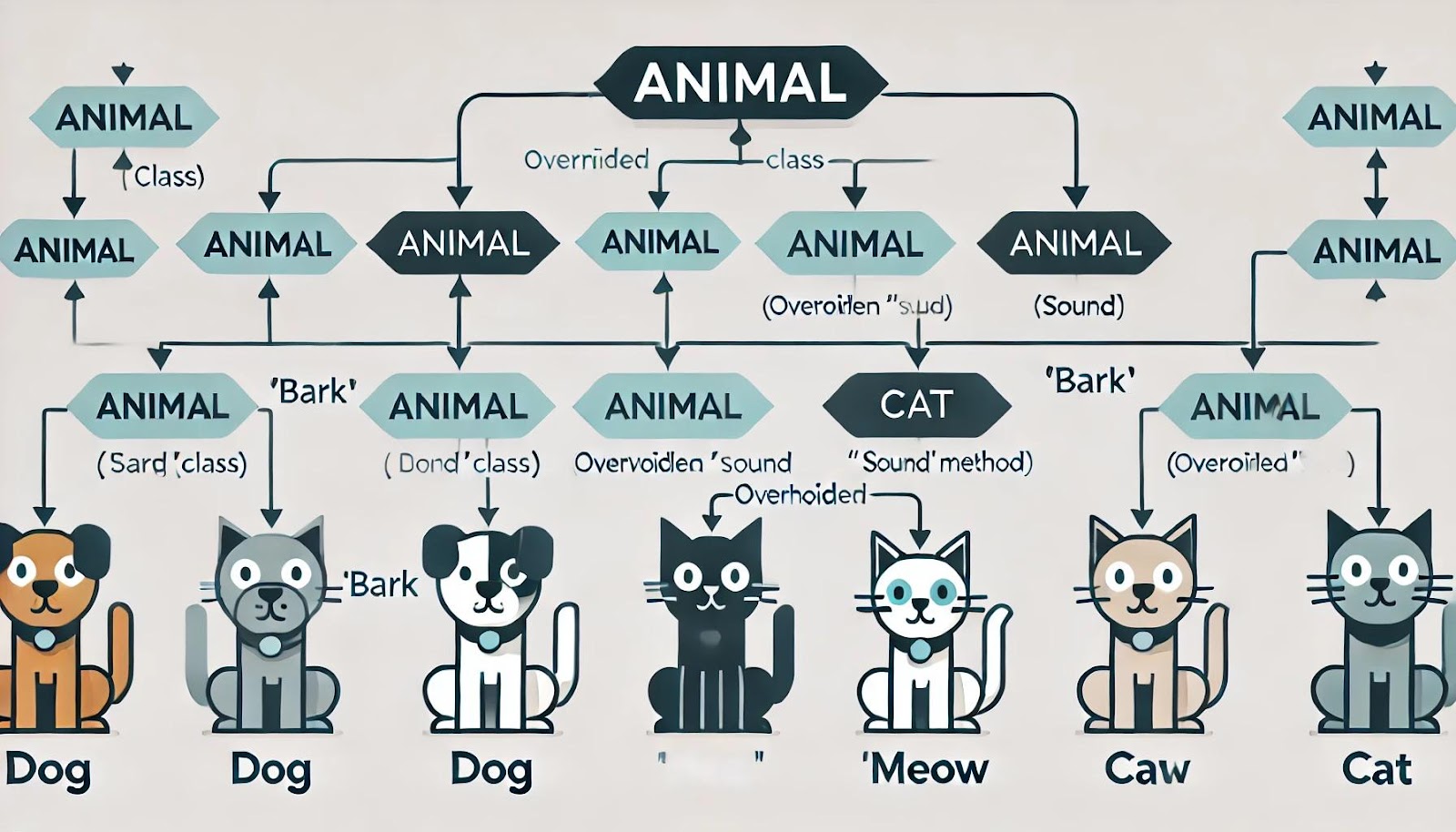
Inheritance allows you to create a new class (child class) based on an existing class (parent class). The child class inherits the attributes and methods of the parent class but can also add its own or modify existing ones.
Example Code for Inheritance
Let’s create a base class Animal and two derived classes Dog and Cat.
class Animal:
    def __init__(self, name, species):
        self.name = name
        self.species = species

    def sound(self):
        return "This animal makes a sound."

# Dog class inherits from Animal
class Dog(Animal):
    def sound(self):  # Overriding method
        return "Woof woof!"

# Cat class inherits from Animal
class Cat(Animal):
    def sound(self):  # Overriding method
        return "Meow!"

# Testing Inheritance
dog = Dog("Buddy", "Dog")
cat = Cat("Whiskers", "Cat")

print(dog.sound())   # Output: Woof woof!
print(cat.sound())   # Output: Meow!
5. Polymorphism
Polymorphism means “many forms.” In OOP, it allows you to use a single method in different ways based on the context. For example, different classes can have their own version of a method with the same name, like sound() in our Dog and Cat classes above.
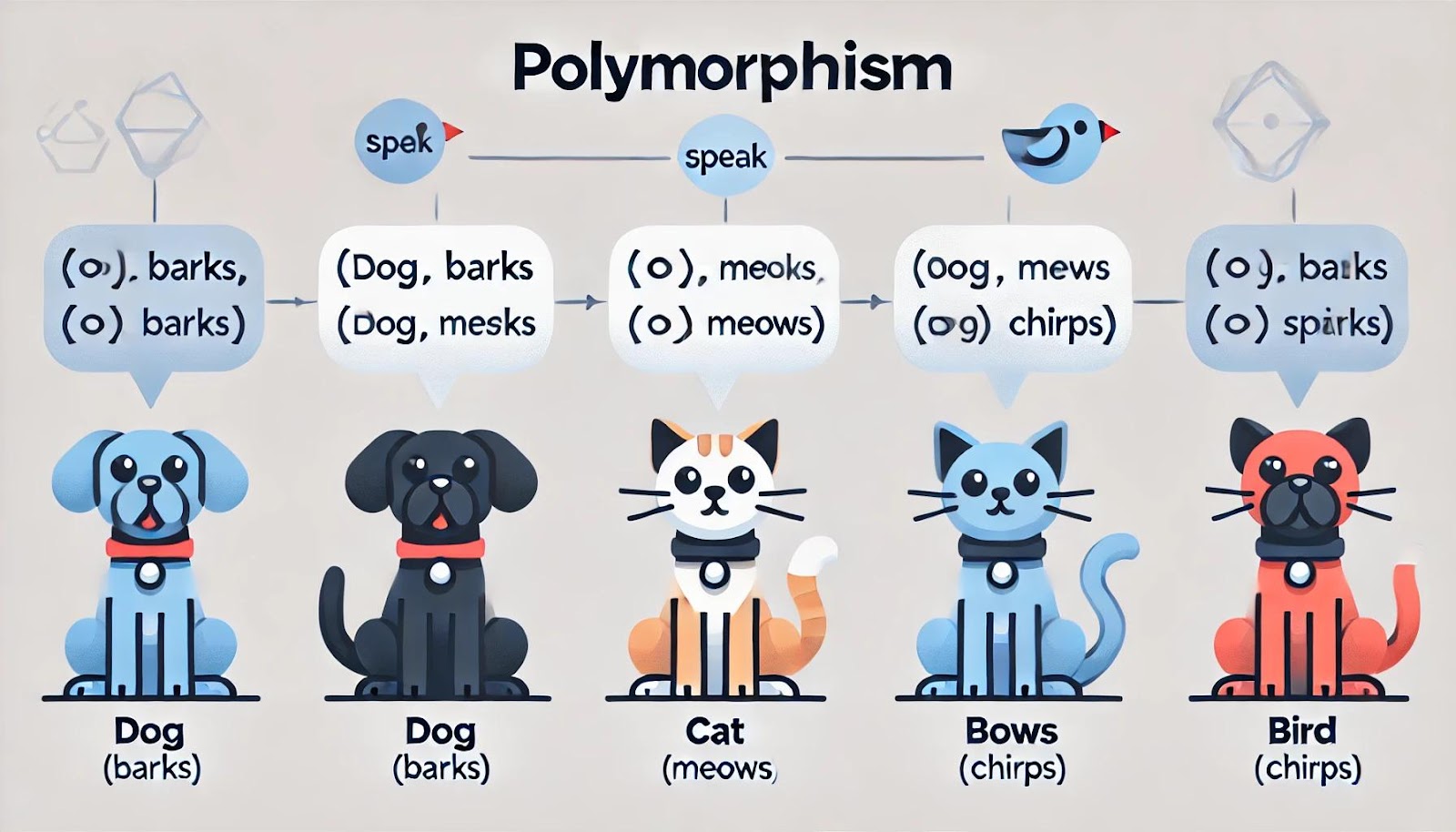
Example Code for Polymorphism
def make_animal_sound(animal):
    print(animal.sound())

make_animal_sound(dog)  # Output: Woof woof!
make_animal_sound(cat)  # Output: Meow!
6. Constructors and the __init__ Method
The __init__ method in Python is a constructor that runs automatically whenever you create a new object. It helps initialize the object’s attributes.
Example Code Using __init__
class Person:
    def __init__(self, name, age):
        self.name = name
        self.age = age

    def introduce(self):
        return f"Hello, I'm {self.name} and I'm {self.age} years old."

person1 = Person("Alice", 30)
print(person1.introduce())  # Output: Hello, I'm Alice and I'm 30 years old.
7. Putting It All Together
To reinforce these concepts, here’s a cohesive example that incorporates encapsulation, inheritance, and polymorphism. Let’s create a simple game where each character is a different kind of Avatar.
class Avatar:
    def __init__(self, name, element):
        self.name = name
        self.element = element

    def power(self):
        return "This Avatar controls the elements."

# Airbender inherits from Avatar and overrides power method
class Airbender(Avatar):
    def power(self):
        return f"{self.name} uses Airbending to control air!"

# Firebender inherits from Avatar and overrides power method
class Firebender(Avatar):
    def power(self):
        return f"{self.name} uses Firebending to control fire!"

# Polymorphism in action
def display_avatar_power(avatar):
    print(avatar.power())

# Create instances of different Avatars
aang = Airbender("Aang", "Air")
zuko = Firebender("Zuko", "Fire")

display_avatar_power(aang)  # Output: Aang uses Airbending to control air!
display_avatar_power(zuko)  # Output: Zuko uses Firebending to control fire!
Final Example Code
Summary
- Classes and Objects: Fundamental building blocks of OOP, allowing you to model real-world entities.
- Attributes and Methods: Properties and behaviors within a class.
- Encapsulation: Keeps data safe and controls access using methods.
- Inheritance: Allows classes to share attributes and methods.
- Polymorphism: Enables different classes to use the same method name with different behaviors.
I encourage you students to try building your own classes and experiment with inheritance, polymorphism, and encapsulation to gain a solid grasp of these OOP principles!


