Introduction
When we talk about “the cloud,” we are using a metaphor that suggests something weightless and intangible. In reality, the internet relies on massive physical infrastructure: Data Centers. As demand for Artificial Intelligence (AI) and high-speed computing accelerates, these facilities are growing in size and number.
For students, residents, and policymakers, understanding how these facilities operate is critical. A common point of confusion, and often contention, is water usage. This article breaks down the mechanics of data center cooling, the chemistry involved, and the crucial difference between a “closed loop” system and a water-neutral one.
<iframe width="560" height="315" src="https://www.youtube.com/embed/JYmu1eNvfNQ?si=dLusazJLhr7dFN-v" title="YouTube video player" frameborder="0" allow="accelerometer; autoplay; clipboard-write; encrypted-media; gyroscope; picture-in-picture; web-share" referrerpolicy="strict-origin-when-cross-origin" allowfullscreen></iframe>1. The Core Challenge: Heat
Servers are essentially heaters that also do math. A single server rack can generate as much heat as a commercial oven. If this heat isn’t removed immediately, the expensive electronics will melt or fail.
To manage this, data centers use liquid cooling systems. This is where the terminology can become confusing.
2. The “Closed Loop” Misconception
The term “closed loop” is frequently used in planning meetings to reassure the public that a facility will not consume water. While technically accurate regarding the internal mechanics, it is often misleading regarding the facility’s total environmental footprint.
A data center cooling system typically has two distinct loops:
- Loop 1: The Internal Loop (The “Closed” Part) This loop circulates treated liquid directly through the server racks to absorb heat. It is indeed a sealed system. The liquid here is never exposed to the outside air and is rarely replaced. It is similar to the coolant loop in a car’s engine.
- Loop 2: The Heat Rejection System (The “Open” Part) The hot liquid from Loop 1 flows into a Heat Exchanger. Here, it transfers its heat to a second medium without the two fluids ever touching. This second medium carries the heat out of the building.
This is the critical decision point. The method used to cool this second loop determines if the data center consumes zero water or millions of gallons.
Scenario A: Dry Cooling (Truly Waterless)
The facility uses giant fans to blow ambient air over radiators (similar to a massive car radiator).
- Water Consumption: Near zero.
- Trade-off: This requires a massive amount of electricity to run the fans, especially on hot days.
Scenario B: Evaporative Cooling (The “Thirsty” Method)
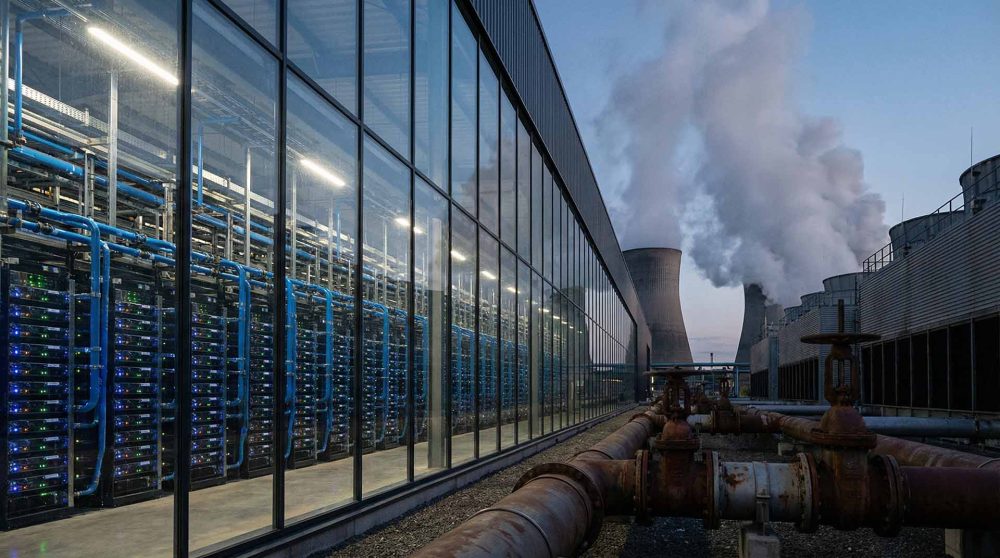
The facility uses Cooling Towers. The heat is transferred to a water loop that is sprayed into the air. As the water evaporates, it takes the heat with it (the same way sweat cools a human body).
- Water Consumption: Significant. Even though the internal server loop is “closed,” the external cooling tower loop consumes water constantly through evaporation.
- Why use it? Evaporation is incredibly efficient. It uses far less electricity than dry fans, lowering the data center’s carbon footprint and power bill, but raising its water footprint.
3. Volume of Water Consumption
If a facility utilizes Evaporative Cooling (Scenario B), the water usage is driven by two factors:
- Evaporation: To cool the servers, water must physically leave the site as steam/vapor.
- Blowdown (The “Flush”): As water evaporates, it leaves behind minerals (calcium, magnesium, salts). If left unchecked, this turns the water in the tower into a thick, salty brine that ruins pumps. Operators must regularly drain this concentrated water (blowdown) and replace it with fresh freshwater (make-up water).
The Numbers: According to Department of Energy estimates and industry averages, a typical hyperscale data center (like those used for AI) using evaporative cooling can consume between 1 million to 5 million gallons of water per day, depending on the weather and server load [1].
4. The Chemical Soup: What is in the Pipes?
You cannot run plain tap water through a data center; it would corrode the metal and breed bacteria. The fluid in these loops is a carefully engineered chemical mixture.
A. The Anti-Freeze (Glycols)
To prevent freezing in winter and aid heat transfer, the closed loops are often filled with a glycol mixture.
- Ethylene Glycol: The industry standard. It is highly efficient but toxic to humans and animals. A leak into the water table is a genuine environmental hazard.
- Propylene Glycol: A non-toxic alternative (used in food machinery). It is safer but less efficient at transferring heat, leading many operators to stick with Ethylene Glycol.
B. Corrosion Inhibitors
The pipes involve various metals (copper, steel, aluminum). To stop them from rusting or reacting with each other, inhibitors are added:
- Azoles (e.g., Benzotriazole): Specifically used to protect copper components. These compounds are toxic to aquatic life and are difficult for wastewater treatment plants to filter out.
- Molybdates & Nitrites: Used to protect steel. Under certain conditions (specifically when interacting with amines), Nitrites can form nitrosamines, which are carcinogenic.
C. Biocides (Life Killers)
Warm, circulating water is a perfect breeding ground for algae and dangerous bacteria like Legionella. To prevent this, the water is treated with biocides:
- Oxidizers: Chlorine and Bromine.
- Non-oxidizers: Isothiazolinones and Glutaraldehyde.
- Function: These chemicals are essentially poisons designed to kill biological organisms.
D. Emerging Concern: PFAS
Some cutting-edge “Two-Phase” cooling systems (where fluid boils directly on the computer chip) utilize fluorinated fluids. These often fall under the category of PFAS (Per- and polyfluoroalkyl substances), known as “forever chemicals” because they do not break down in the environment [2].
5. Environmental Impact & The Trade-Off
There is no “perfect” cooling solution; there is only a trade-off.
- If we ban water use (Dry Cooling): The data center consumes significantly more electricity. If that electricity comes from coal or gas, carbon emissions rise.
- If we prioritize energy efficiency (Evaporative Cooling): The data center consumes millions of gallons of local water and discharges concentrated mineral/chemical brine into the wastewater system.
Bottom Line
When a new data center project is announced as a “closed loop” system, it is not an attack to ask for clarification—it is due diligence. The “closed” nature of the server loop does not guarantee that the facility is water-neutral.
For students and citizens alike, the key questions to ask are:
- Does the facility use Evaporative Cooling Towers or Adiabatic Cooling?
- If so, what is the projected Water Usage Effectiveness (WUE)?
- What specific chemical inhibitors will be used, and how is the “blowdown” water treated before returning to the municipal sewage system?
References & Further Reading
- [1] U.S. Department of Energy – Water Management in Data Centers Citation for water usage volumes and efficiency metrics. Link to energy.gov resources
- [2] “The Forever Pollution” – PFAS in High Tech Discussion on the use of fluorinated fluids in advanced electronics cooling.
- [Video] How Data Centers Manage Intense Heat A visual guide to the different cooling loops discussed in this article. Watch on YouTube
- Lawrence Berkeley National Laboratory – United States Data Center Energy Usage Report Provides foundational data on energy vs. water trade-offs.